.png)
BangladeshNationalist Party-BNP

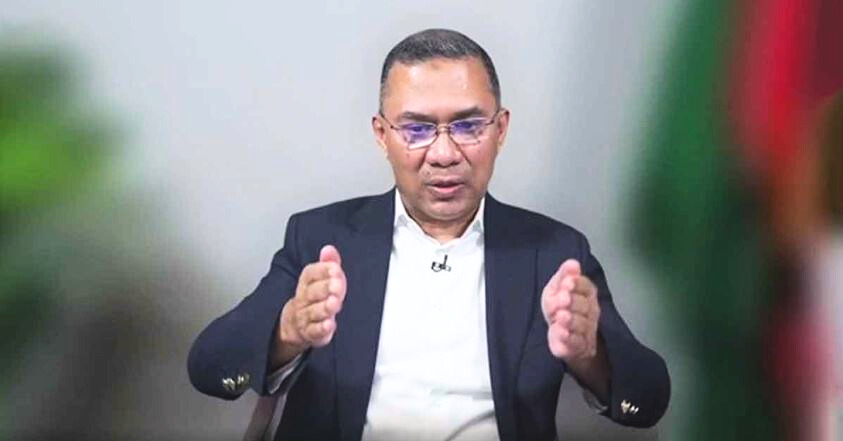
After the fall of the Awami League government in the July uprising, Bangladesh is now being governed by an interim administration. The government has already announced that the national elections will be held in February. In this post-uprising context, BNP’s Acting Chairman Tarique Rahman joined BBC Bangla for a virtual interview from London. In this interview, he discussed his party’s strategy for the upcoming elections, the political situation following the Awami League’s fall, justice for their leaders and activists, and the BNP’s stance on various contemporary issues.
Here is the full text of the interview published on Monday:
Question: How are you doing? How have you been spending your time lately?
Tarique Rahman: Alhamdulillah, I’m doing well physically. Life has been quite busy as usual. Although I’m living abroad, mentally and emotionally I’ve remained in Bangladesh for the past 17 years.
Question: We’re speaking at a critical juncture in Bangladesh’s history. In 2024, a historic mass uprising brought an end to the Awami League’s 15-year rule. The country is now heading toward elections in a few months. You’ve been appearing at several party events recently, but you haven’t spoken to the media for a long time. Why is that?
Tarique Rahman: It’s not entirely true that I haven’t spoken. I’ve been in exile for 17 years, but since taking responsibility for the party, I’ve been in constant communication with our leaders, activists, and the general public through various means. During the previous autocratic regime, a court order explicitly barred me from speaking publicly. Even if I wanted to speak, the media couldn’t publish it due to government restrictions. I once spoke at the Press Club, and afterward, its committee even decided that “fugitives” couldn’t address the club again. So, the regime tried to silence me. But I continued speaking — through social media and other channels. I didn’t stop.
Question: I meant interviews, particularly during the past year after the mass uprising. Many expected that you would return to Bangladesh and lead the party in person after the fall of the Awami League. Why haven’t you returned yet?
Tarique Rahman: For some understandable reasons, I haven’t returned yet. But I think the time has come. InshaAllah, I’ll be back soon.
Question: Can you tell us when that might be?
Tarique Rahman: Very soon, InshaAllah.
Question: So can we say there’s a possibility you’ll return before the election?
Tarique Rahman: As a political worker, I believe politics and elections are deeply connected. Since this upcoming election is the people’s long-awaited one, I want to be among the people when it happens, InshaAllah.
Question: Some of your party members have said that security concerns might be keeping you from returning. Do you feel any such concern?
Tarique Rahman: We’ve heard many such concerns from different quarters, including even from members of the former government themselves. But I’m not personally worried.
Question: There’s been much discussion about your role in the July uprising. Some have even called you the “mastermind” behind it. Do you see yourself that way?
Tarique Rahman: Not at all. I don’t see myself as the mastermind of the July movement. The uprising’s background was built over many years through the struggles of democratic political parties — BNP and others alike. People from all walks of life participated: students, housewives, workers, farmers, rickshaw and CNG drivers, shopkeepers, even retired military officers. Journalists who were once exiled because of oppression also joined. So no single person or party can claim ownership of this movement. The real mastermind was the people of Bangladesh who believe in democracy.
Question: During the movement, how much communication did you have with student leaders and others on the ground?
Tarique Rahman: Naturally, I had to rely on online communication since I was abroad. And as you know, the autocratic government at that time severely disrupted communication systems.
Question: After the uprising, different groups claimed credit for it. Do you think this rivalry has harmed unity among democratic forces, and does BNP share any responsibility?
Tarique Rahman: The July uprising was a historic event. Over 2,000 people were killed, and around 30,000 were injured or disabled. Among them, 63 were children. No other movement in our history saw such sacrifice. So, rather than fighting over credit, we should stand by the families of the martyrs, support them, and honor their sacrifices.
Question: The interim government, led by Professor Muhammad Yunus, has announced elections in February. Do you trust that timeline?
Tarique Rahman: BNP has always said that the sooner elections are held, the sooner stability will return. For 17 years, the people were denied their political and economic rights. Poverty and unemployment rose, education and healthcare collapsed, and agriculture suffered. We wanted elections by December, but if it’s in February, we hope the government will take all necessary steps to ensure a fair process.
Question: Will BNP contest the election alone or through alliances?
Tarique Rahman: We’ve worked with nearly 64 democratic parties during the anti-autocracy movement. We plan to rebuild the nation collectively. Our 31-point reform plan reflects input from our allies — because we want to govern with everyone’s participation.
Question: Jamaat-e-Islami has hinted at forming a separate alliance. Do you see that as a concern?
Tarique Rahman: Any party that operates within the law has the right to do politics. I don’t see any reason for concern. Competition is part of democracy.
Question: What will be your nomination strategy this time?
Tarique Rahman: We’ll prioritize candidates who are closely connected with their communities, aware of local issues, and have broad public support — not just party influence or money. We want candidates whom people trust.
Question: Will grassroots opinions matter this time?
Tarique Rahman: Absolutely. We’re not just nominating party favorites — we’re looking for people who enjoy support across all classes, professions, and communities.
Question: Will you personally contest the upcoming election?
Tarique Rahman: InshaAllah, yes.
Question: So, if BNP wins, can people expect you as the next Prime Minister?
Tarique Rahman: That decision rests with the people of Bangladesh and the party.
Question: What role will Begum Khaleda Zia play in the election?
Tarique Rahman: She is a symbol of Bangladesh’s struggle for democracy. Despite her illness and persecution, her contributions remain immense. If her health permits, she will certainly play some role.
Question: What about the future leadership of BNP — will the family continue to dominate?
Tarique Rahman: Leadership isn’t about family. It’s about support and merit. I’ve endured imprisonment, torture, and defamation for the cause of democracy. Leadership comes from commitment and the ability to unite people — not lineage.
Question: Will your wife or daughter enter politics in the future?
Tarique Rahman: Time will tell.
Question: What’s the difference between the BNP of 2001–2006 and today’s BNP?
Tarique Rahman: The world has changed. COVID-19 and the digital revolution have transformed societies and mindsets. Our focus now is on people’s well-being — how every class can live a better life. Our policies will reflect these new realities.
Question: During BNP’s last term in government, there was a lot of criticism over many issues — particularly allegations of corruption. Many of your ministers and party figures were accused of corruption, and Bangladesh’s ranking on the corruption index at the time was heavily criticized. How would you assure voters that such a situation will not happen again?
Tarique Rahman: Look, you mentioned the term “champion in corruption.” Let’s recall the timeline properly. From 1996 to 2001, it was the Awami League government in power. BNP won the election on 1 October 2001 and formed the government on 10 October, if I remember correctly. Only two or three months later, a Transparency International (TIB) report was published.
Now, logically speaking — can a newly elected government, within just two or three months, have any significant impact on corruption levels in a country? Of course not. So that particular index clearly reflected the performance of the previous government — the Awami League’s five years in power.
If you look at TIB’s subsequent reports, from 2001 until we handed over power to the caretaker government in 2006, you’ll see — and this isn’t my claim but their own data — Bangladesh’s corruption ranking gradually improved.
I do admit, we could not eradicate corruption entirely. It’s a deep-rooted social disease — not something that can be wiped out overnight. This requires public awareness, institutional reforms, and time.
Words alone won’t be enough — we’ll have to prove it through our actions. So, my assurance to the voters is this: if people give us the opportunity again, we’ll do everything possible to build a system where Bangladesh can, at least to some extent, hold its head high before the world with dignity.
Question: After the 5th of August uprising, there have been repeated allegations against BNP activists of extortion and illegal occupation of property. Your party has expelled many members, but such allegations keep surfacing. Why hasn’t this stopped?
Tarique Rahman: I agree with your observation, but I want to clarify a few points. You’ve probably seen in the media that we’ve already taken organizational action against around 7,000 members. But not all of them were accused of such crimes — many were disciplined for other organizational issues.
When we received specific complaints, we investigated. And yes, we found different types of cases. Let me give you two examples.
In one case, two brothers in a village had a family dispute over inherited property. One brother had a close connection with someone in the former autocratic regime. Using that connection, he forcibly took over the other brother’s property.
After the fall of that autocratic regime, the power dynamics changed — the collaborator fled. Naturally, the brother who had been deprived of his lawful property went to reclaim it. Coincidentally, that brother happened to be a BNP supporter. Immediately, the other side began spreading propaganda — claiming that “BNP men are grabbing land.”
There were many cases like that.
Another example — during the 17-year autocratic rule, over five million of our party members faced false and fabricated cases. Many had to flee their homes, abandon their businesses, shops, and lands. During that time, the regime and its allies occupied many of their properties.
After August 5, when the regime fell, those collaborators fled too. Our activists then went to reclaim their own legitimate properties. And once again, propaganda began — “BNP is grabbing property.”
Yes, I admit — in some genuine cases, there were wrongdoings, and we took action wherever we found proof. But let me make something clear — a political party’s role is not to perform police duties. We can discipline our members, but law enforcement is the responsibility of the state.
Our question is — why isn’t law enforcement doing its job? Why is the government failing in its responsibility?
Question: So, you mean the government has failed in this regard?
Tarique Rahman: Absolutely. As I said — maintaining law and order is the government’s job, not the party’s.
Question: Then can we assume that if BNP forms the next government, there will be zero tolerance for extortion or land grabbing, even if done by your own party members?
Tarique Rahman: Yes — law enforcement will do its duty, and the party will do its part. If, Insha’Allah, BNP forms the government and any of our members are found involved in unethical or criminal activities, the party will not protect them. We’ll take a firm stance against them, both organizationally and in accordance with the country’s laws.
Maintaining law and order is the responsibility of the police and security forces — they’ll do their job, plain and simple. It’s as straightforward as two plus two equals four.
Question: Let’s move to the recent Dhaka University Central Students’ Union (DUCSU) election. The results have generated significant discussion — the Islami Chhatra Shibir-backed panel won by a large margin over the BNP-backed Chatradal panel. How do you view this outcome?
Tarique Rahman: I see it as a positive step in our democratic journey — a good beginning, indeed.
First, congratulations to those who won. And to those who will win in the future, I also extend my best wishes in advance.
It’s an encouraging start, though I would have preferred it to be completely free of controversy. I hope future student elections will be held in a more transparent and dispute-free manner.
Question: Do you think the DUCSU election results could have an impact on national politics — especially with the general election approaching?
Tarique Rahman: Not really. As senior student leader Mr. Mahmudur Rahman Manna — a two-time DUCSU VP and an experienced politician — said, student politics and national politics are different arenas. I agree with that.
Question: Coming to Jamaat-e-Islami — recently, many BNP leaders have been openly critical of them. What’s your personal view on Jamaat now?
Tarique Rahman: As long as any political party operates within the framework of the Constitution and the law of the land, they have the right to do politics. BNP has always believed in a multi-party political system, and we still do.
So, we see this matter from that perspective — anyone following the country’s laws has the right to engage in politics. In fact, we encourage political diversity.
Question: Jamaat was once your political ally. Yet many BNP leaders now criticize their role during the Liberation War. How do you reconcile that, given that BNP once formed a coalition government with them?
Tarique Rahman: Just as those who committed murder, enforced disappearances, and mass repression during the last 17 years must face justice, any political party that played a controversial role in 1971 must also face accountability.
Each must answer for their own actions. I can take responsibility for mine, not for what others did. Justice must be equal for all — no exceptions.
Question: Coming back to the Awami League — after the July uprising, what is BNP’s current position regarding them?
Tarique Rahman: I’ve been in exile for 17 years. I came abroad for treatment after being physically tortured during the so-called 1/11 regime.
When I left, I left behind my younger brother — he is no longer alive. I left behind my healthy mother — she is now unwell and has endured unspeakable mental and physical abuse. I left behind my home — the house where my father’s memories lived, where my brother and I grew up, where our children were born. That house has been destroyed — reduced to rubble.
But this is not just my story, or my family’s story — this is the story of thousands of Bangladeshi families. Fathers, brothers, and sons — tortured, imprisoned, killed, and disappeared. Their homes burned down, their livelihoods destroyed.
Those responsible for these injustices — those who gave the orders — must face justice. This is not about revenge; it’s about justice, about upholding the law.
Question: Some BNP leaders have said that despite demanding trials for those crimes, they do not support banning any political party, including the Awami League. With the election approaching, can the Awami League still do politics, in your view?
Tarique Rahman: If a party has committed crimes, then they must face justice according to the law of the land. It’s a legal matter, and the courts will decide. Whether it’s an individual or a party — anyone guilty of wrongdoing must be held accountable.
Question: Personally, do you think the Awami League should still have a place in Bangladesh’s politics?
Tarique Rahman: We, in BNP, believe that all political power comes from the people. And I firmly believe that a party or individuals who have murdered, abducted, looted, and plundered the people’s wealth cannot have the people’s support.
If the people reject them, there’s no reason for them to survive politically. Since we believe in people’s power, we also believe the ultimate judgment lies with the people.
In this matter, the greatest judge — is the people of Bangladesh.